Office Furniture Supplier vs Fit-Out Contractor in Malaysia: Who to Hire for What
- One question sorts most projects: does the work touch the building, or only what stands on the floor? Furniture stands on the floor. Everything fixed to the shell is fit-out scope.
- A furniture supplier is enough when the space is already fitted and working — a desk refresh, extra workstations into an existing bay, screens added to a floor that already has power where you need it.
- You need a fit-out contractor the moment hoarding goes up, ceilings come down, power and air-conditioning move, floors are relaid, or a wall goes up to structure.
- Work that touches the building drags in parties who never appear on a furniture order: the landlord, building management, and — where the building holds a fire certificate — the Fire and Rescue Department, which must be notified before a material change is begun.
- Anyone carrying out construction work as a contractor in Malaysia has to be registered with CIDB under section 25 of Act 520. A furniture invoice does not cover site work.
- UA Office sits on both sides of the line: a Malaysian furniture manufacturer since 1991 that also runs office fit-out, so a job needing both does not need two contracts.
Every office project starts with a phone call to the wrong company at least once. A tenant with a signed lease and a bare unit rings a furniture showroom; a tenant who needs sixty more desks rings an interior contractor. Both calls get answered politely, and both waste a fortnight.
The two trades are not competing for the same job. They are two different jobs that happen to finish in the same room, and the decision in front of you is a scoping decision before it is a supplier decision: work out how far into the building your project reaches, and the right party to call becomes obvious.
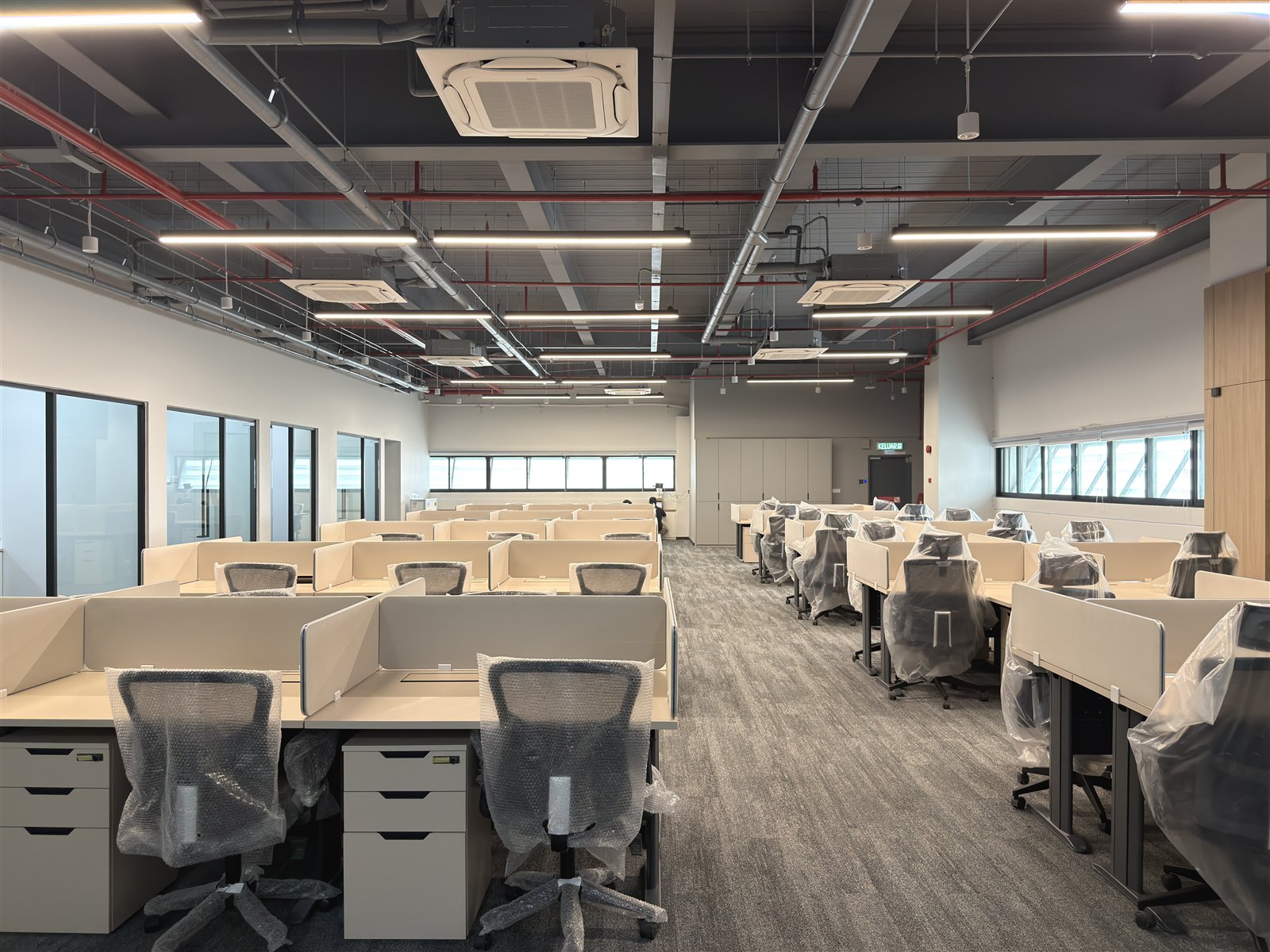
An IT group HQ in Shah Alam, photographed at handover. The panel workstations and the chairs — still wrapped — came off a furniture order. The exposed-services ceiling, the light strips, the sprinkler runs, the carpet and the glazed rooms on the left did not.
The line between the two jobs
An office furniture supplier provides what sits on the finished floor: workstations, task and executive seating, storage, meeting and boardroom tables, reception furniture, screens and panels. A manufacturer goes further than a reseller — it makes those items to your dimensions and finishes rather than picking them off a price list — but the boundary of the trade is the same. The supplier delivers, positions and installs. It does not put a hole in the slab.
An office fit-out contractor builds and finishes the space itself: hoarding and protection, demolition and stripping out, partition walls, ceilings, flooring, painting, and the mechanical and electrical work — lighting, power, data, air-conditioning, sprinkler and detector relocation. It runs the site: trades in sequence, a programme, safety on the floor, and the paperwork that goes to the landlord and the authorities.
Put crudely, the supplier is responsible for objects and the contractor is responsible for the room. The awkward projects are the ones where an object turns out to need the room changed.
The scope line, drawn by item. The amber column is the part nobody owns by default — it is furniture in shape and construction in consequence, and it is where two-vendor projects usually come unstuck.
When a furniture supplier is all you need
More often than the industry likes to admit. A furniture-only route is the right one when the shell already does its job and you are changing what stands inside it. In practice that means:
- A furniture refresh in a working office. Old desks out, new desks in, over a weekend, with nothing switched off and nobody displaced.
- Growth into space you already hold. Twelve more positions in a bay that already has lighting, air-conditioning and floor boxes where the desks are going.
- Loose furniture only. Meeting tables, seating, mobile pedestals, breakout pieces — anything that arrives finished and leaves in a lorry when you move.
- Screens and panels into an existing fitted space. Adding partition and panel runs to divide an open bay, where the panels stand on the floor and clip to the desks rather than fixing back to the shell.
- Taking over a unit that was fitted by the last tenant. Ceilings, lighting and air-conditioning are there and working; you need the floor populated, not rebuilt.
The tell is the services. If nothing has to be switched off, moved, re-routed or re-certified, and the landlord has no reason to care what arrives at the loading bay, a supplier alone is the cheaper and faster answer. Bringing a main contractor into a desk order adds a management layer that has nothing to manage.
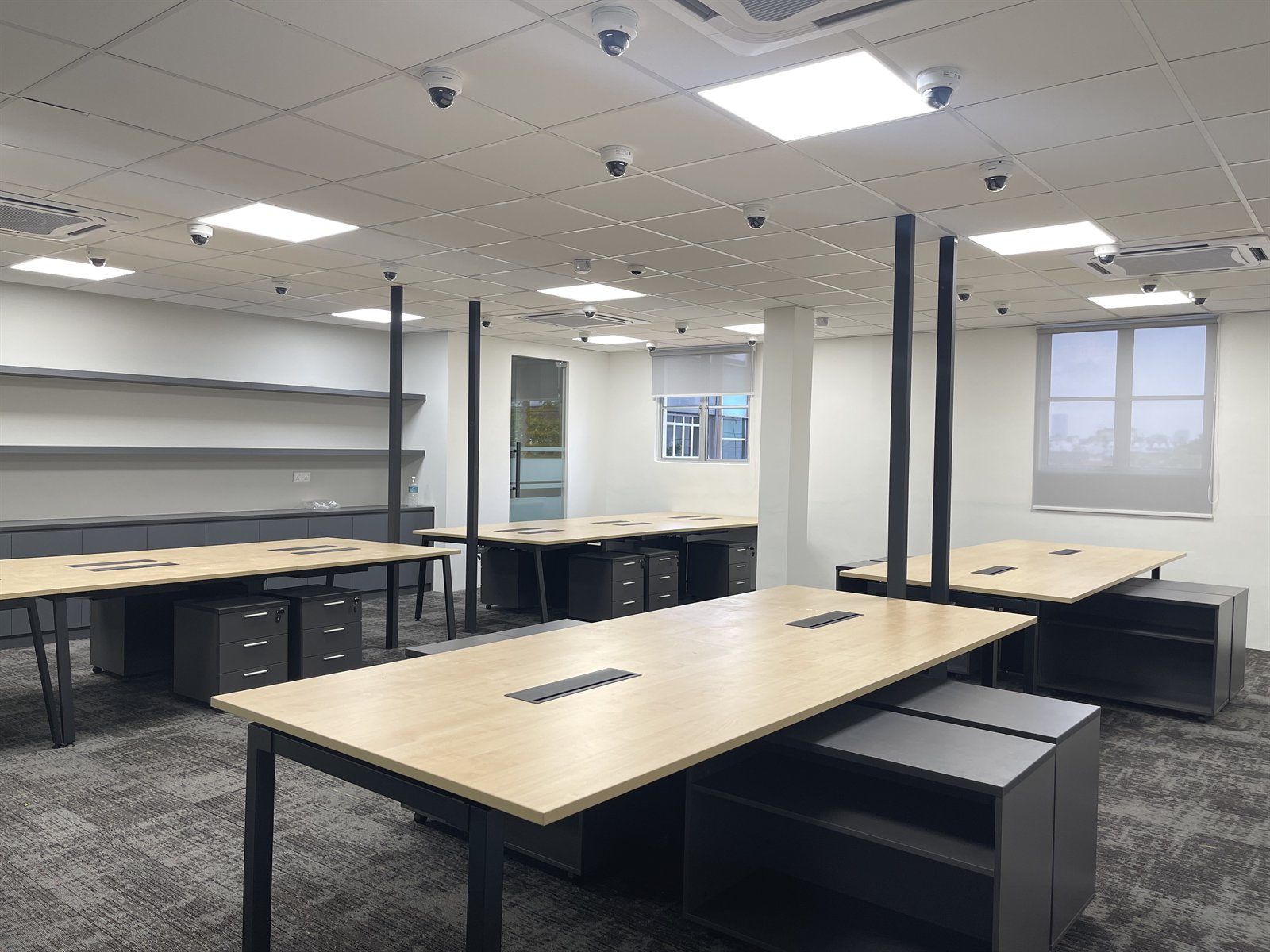
A jewellery brand HQ in Ampang. Everything you can move — the bench desks, the pedestals, the low storage on the left — is a furniture order. The ceiling grid, the recessed lighting, the blinds, the carpet and the glazed room at the back were built first.
Walk your plan and ask, for each change: would the building manager need to know about this? If the answer is no for every item, you have a furniture project. One yes turns it into a fit-out project with a furniture order inside it — which is a different thing to buy.
When the job is fit-out scope
The threshold is lower than most tenants expect, because a lot of it is invisible on a mood board. Any one of these puts you in fit-out territory:
- Hoarding, protection and stripping out. A site that has to be closed off from occupied floors is a site, with everything that follows: access control, waste removal, protection of common areas.
- Partition walls to structure. A room you can hear through is furniture; a room built up to the slab, with a door frame, an architrave and a paint finish, is construction.
- Ceilings. Anything that opens the grid, changes the ceiling line, or hangs a bulkhead.
- Mechanical and electrical. Moving power and data outlets, adding circuits, relocating air-conditioning diffusers, moving lights, and touching sprinkler heads or smoke detectors when a wall lands under one.
- Flooring. Lifting and relaying carpet or vinyl, levelling screed, changing floor boxes.
- Anything requiring a submission. Landlord approval of drawings, building-management permits, and, in a certificated building, notice to the Fire and Rescue Department.
None of that is furniture work, and none of it is something a furniture company should be quoting on unless it also holds the trade. This is where the cost profile changes shape as well — the drivers behind a fit-out number are a separate subject, set out in our guide to what actually moves an office fit-out cost.

A trading floor. The circular feature ceilings, the downlighting, the glazed edge and the locker wall are contractor work with a programme behind them; the desk runs and monitor arms are a furniture order that has to land inside dimensions somebody else has already set.
What the building itself demands
This is the part that surprises tenants who have only ever bought furniture. The moment work touches the shell, two more parties join the project, and neither of them is on your invoice.
The landlord and building management
Most managed office buildings in the Klang Valley issue a fit-out guideline to incoming tenants, and it governs the practical shape of the works: drawings submitted for approval before anything starts, which trades may work when, how the goods lift and loading bay are booked, protection of lobbies and lift cars, waste removal routes, and the conditions on any fit-out deposit held against damage. Noisy or dusty work in an occupied building is commonly pushed outside office hours. The specifics — deposit amounts, approved-contractor lists, insurance requirements, permitted working windows — are set by each landlord or management office, not by any national rule, so the guideline for your building is the document that matters.
The practical consequence is a workload, not just a cost. Somebody has to produce the drawings, submit them, chase the approval, book the lifts, and be the name on the permit. A furniture supplier delivering desks has no standing in that process and no reason to hold it.
Fire safety, where the building holds a certificate
Malaysian law is specific here, and it puts the duty on the occupier rather than on whoever you hired. Under section 32(2) of the Fire Services Act 1988, where the occupier of designated premises “proposes to make a material change to the premises while a fire certificate is in force… he shall, before the carrying out of the proposals is begun, give notice of the proposals to the Director General” — and beginning the work without that notice is an offence. The same Act defines a fire-hazard to include “any unlawful alteration to any building such as might render escape from any part thereof in the event of a fire materially more difficult”.
Read that against a floor plan and the relevance is immediate. A partition layout that lengthens a travel distance to an exit, a full-height wall that lands under a sprinkler head, a storage run that narrows a corridor — those are fire-safety questions before they are furniture questions, and the tenant carries the obligation. Whether your particular building is designated premises holding a fire certificate, and what its management office requires by way of Bomba or local-authority submission, has to be checked for the actual address — it does not apply uniformly to every office unit.
Who is allowed to do construction work
The other statutory point is about the contractor, not the building. Registration with the Construction Industry Development Board is mandatory: under section 25 of Act 520, all contractors, local or foreign, must be registered with CIDB before undertaking and completing construction work in Malaysia, subject to the exemptions in section 40(1).
If a quotation covers demolition, partitioning, ceilings and M&E, ask who holds the registration and under whose name the works are being carried out. It is a two-minute question at tender stage and an expensive one after a stop-work notice.
The middle ground, where most offices land
Very few projects sit cleanly on one side. The common Malaysian office job is a relocation or a renovation with a furniture order inside it, and the interesting decisions are all in the overlap.
Three examples of items that look like furniture and behave like construction:
- Workstation runs carrying power and data. The panel spine is a manufactured product; the supply feeding it is an electrical scope. Somebody has to agree where the feed drops, who terminates it, and who tests it. Specifying the workstation layout and the power route as one conversation avoids a floor of desks with nowhere to plug in.
- Reception counters, pantry runs and full-height storage. Fixed to the building, built on site, finished against surfaces that are never quite straight. Which of these should be built in and which should stay movable is its own decision, and we have set it out separately in built-in versus loose office furniture.
- Storage used to divide space. A run of cabinets doing the job of a low wall is furniture on the asset register and a layout element on the drawing — and if it lands across a diffuser or an emergency light, it becomes a coordination item too.
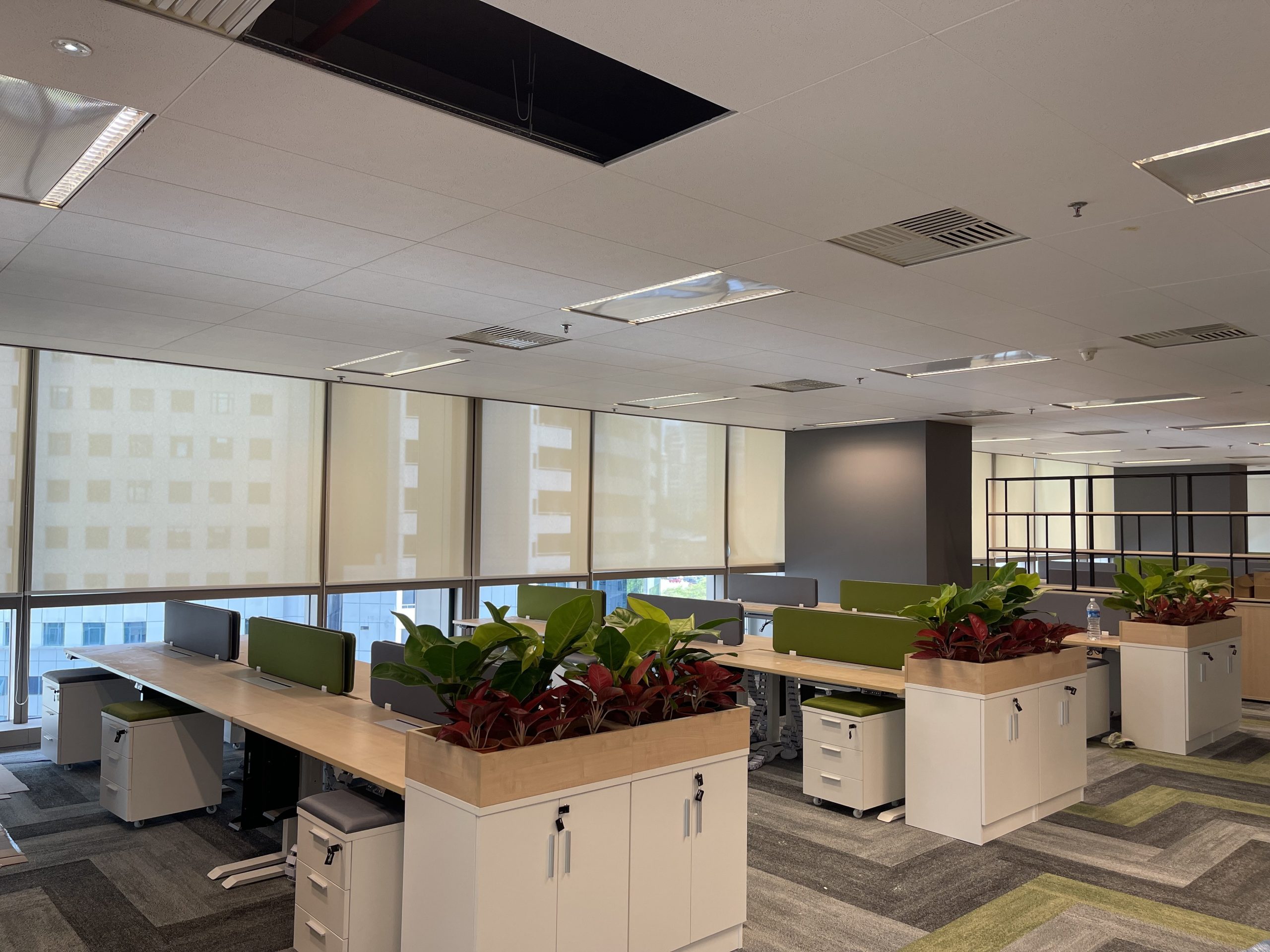
A hotel operator’s KL office. The planter-topped storage spines are furniture, and they are also doing the space-planning job of a low wall. Note the open ceiling tile at the top of the frame: the power and data feeding those desk runs live above the grid, which is why layouts like this get drawn with both trades in the room.
Three routes, side by side
| Furniture supplier only | Fit-out contractor only | One team — manufacturer + fit-out | |
|---|---|---|---|
| Right when | The space works; you are changing what stands in it | The space needs building, and furniture is being handled elsewhere | You are relocating or renovating and want one party accountable for the finished office |
| Scope | Desks, seating, storage, tables, screens; delivery and install | Hoarding, partitions, ceilings, flooring, M&E, finishes, site management | Both, drawn and programmed together |
| Who talks to the landlord | Nobody needs to | The contractor, for the build | One party, for the whole works |
| Furniture fit to the built space | Planned against what already exists | Outside their scope — usually bought in late | Drawn from the same dimensions being built to |
| Contracts you hold | One | One for the build, plus a separate furniture order | One |
| At handover | Supplier answers for the furniture | Contractor answers for the build; the furniture is someone else’s | One party answers for the room and the contents |
| Usual failure mode | Furniture that fits the plan but not the services | Furniture ordered last, arriving after the move-in date | Fewer seams, so fewer places to lose a dimension |
Where the seam splits
The two-vendor route is normal and it works on plenty of projects. It fails in three predictable places, and all three are seams rather than failures of skill.
Dimensions agreed twice. The clearance between a partition bay and the first desk row is a construction dimension and a furniture dimension simultaneously. When two companies each hold half of it, the tolerance gets absorbed by whoever installs last — which is the furniture, arriving into a bay that turned out 40 mm narrower than the drawing.
Sequencing owned by nobody. Made-to-order furniture has a production lead time. If that lead time is not sitting inside the construction programme, it gets started when the build looks nearly finished, which is several weeks too late. The build being late is visible on site; the furniture being late is invisible until it is not.
Accountability at handover. When the desk depth does not match the bay, or the floor box lands under a pedestal, each party has a defensible position and you have a problem. Nothing about that is bad faith. It is what happens when a project is divided at exactly the point where it should be coordinated.
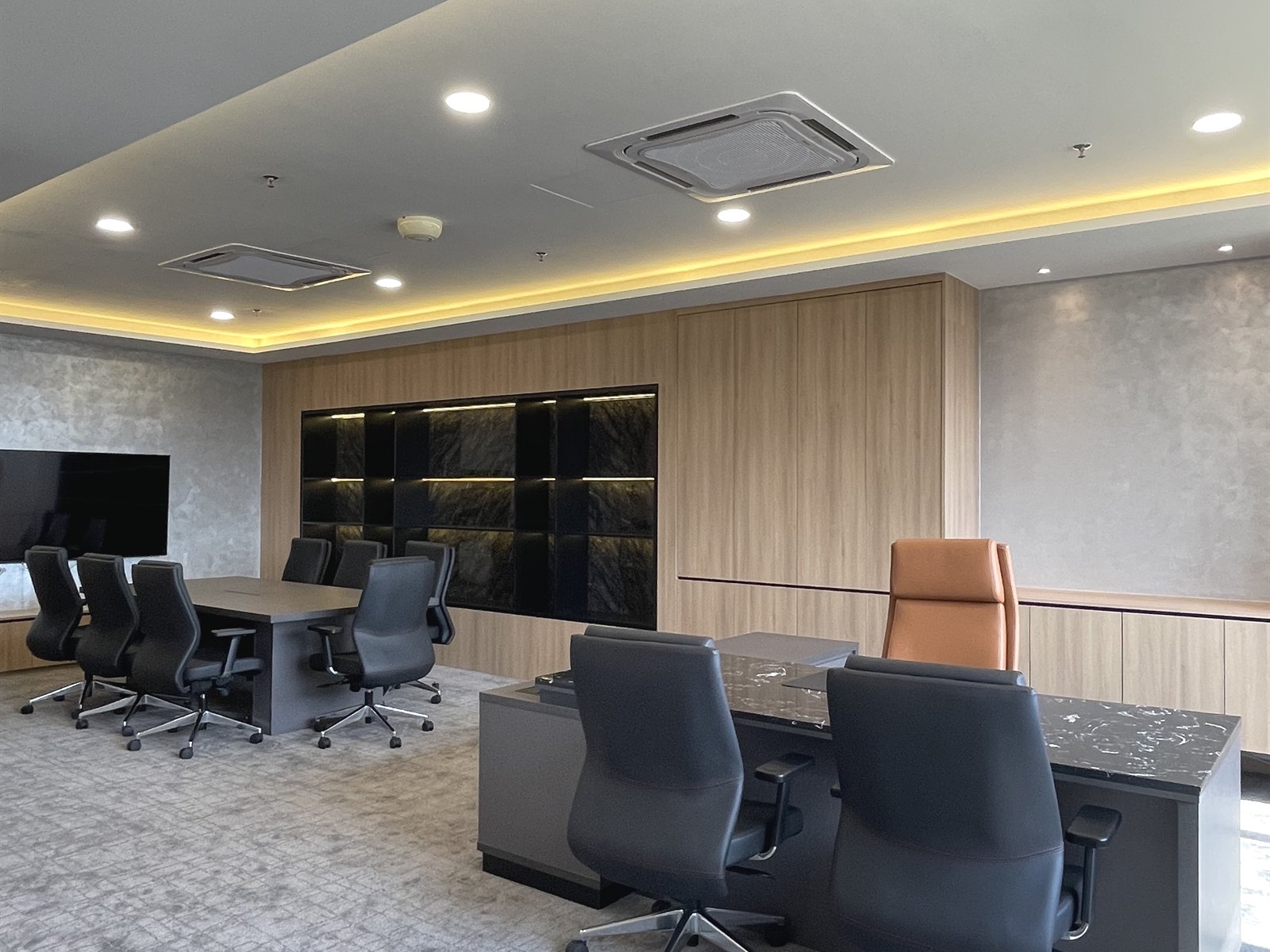
An education foundation’s executive suite in Putrajaya. The timber wall, the backlit stone panel and the cove lighting are contractor scope; the desk, the boardroom table and the seating are furniture. They share a finish palette because one schedule covered both.
One team on both sides
UA Office has manufactured office furniture in Malaysia since 1991, made to order, in our own factory. Head office, factory and showroom share one address in Seri Kembangan, Selangor, and we install across Peninsular Malaysia. We also run office fit-out, which is the less usual half of that sentence — most furniture houses stop at the delivery door, and most interior contractors buy their furniture in.
What that changes on a project is narrow and worth being precise about. It does not change what a desk or a partition costs; materials cost what they cost. It changes the number of seams. The furniture is drawn from the same dimensions the space is being built to. The production lead time sits inside the construction programme rather than being discovered at the end of it. Finish references are held once, across the joinery and the loose pieces. And when something needs answering at handover, there is one party to ask.
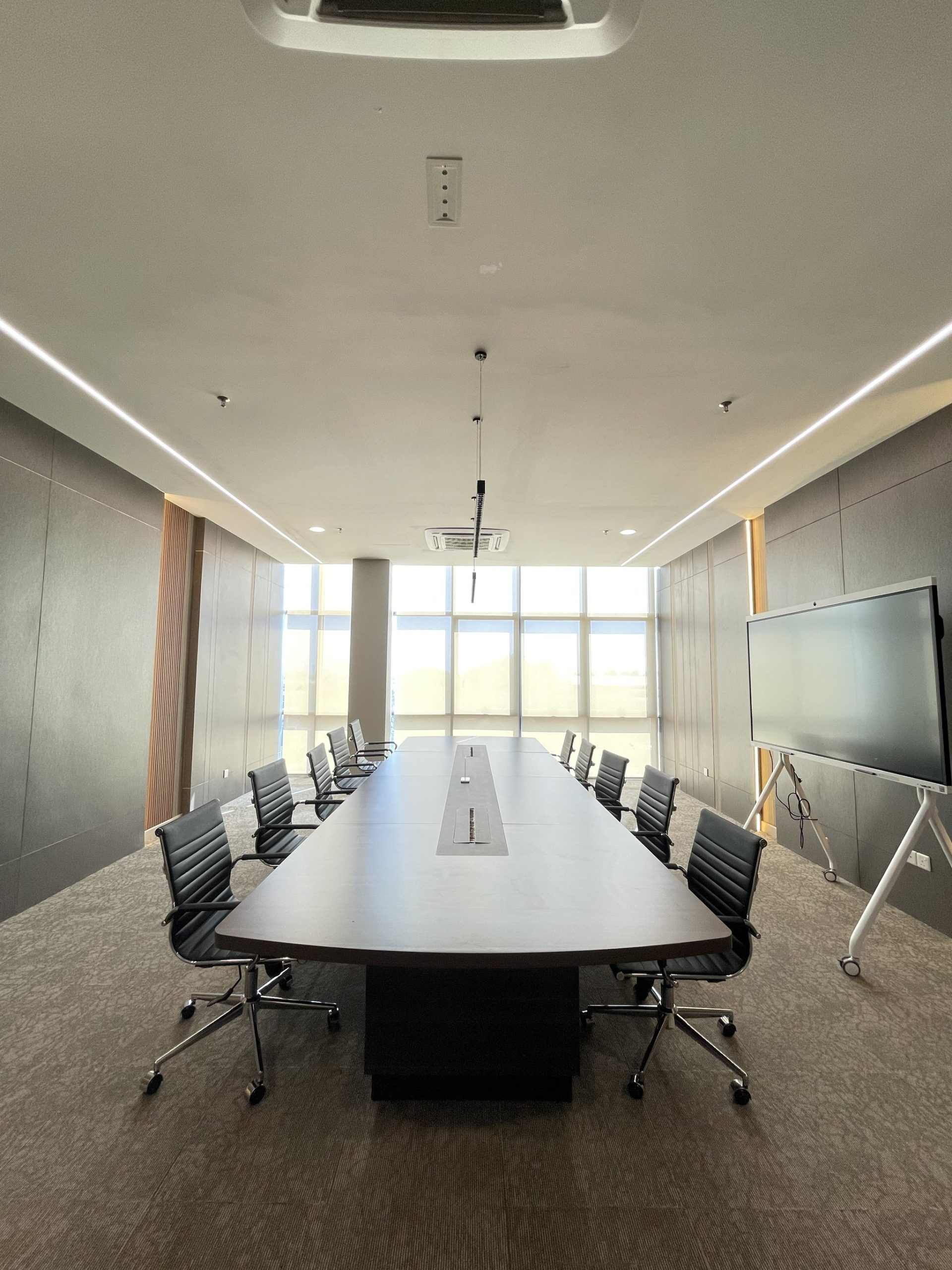
A Kuala Lumpur boardroom. The table and chairs were supplied and installed as furniture; the wall panelling, the recessed lighting line and the ceiling AV mount were built. On a two-vendor job, the junction between the table’s cable spine and the floor service is the detail that gets discovered last.
Because we manufacture what we install, furniture we supplied can be dismantled and reinstalled when you move, with the original drawings and finish references already on file. That is a furniture-side capability rather than a fit-out one, and it tends to matter at the far end of a lease rather than at the start of a project.
What to send before anyone quotes
Whichever route you take, the same five things turn a vague enquiry into a real number. Send them once, to whoever you are asking.
- The floor plan of the unit you are taking or already occupy — a landlord’s CAD or PDF is ideal, a marked-up printout is workable.
- Headcount now and the number you are planning for, split by team if the teams need separating.
- The condition you are starting from. Bare shell, fitted by the last tenant, or occupied and staying occupied while the work happens — this single answer decides most of the scope.
- The landlord’s fit-out guideline, if you have been issued one. It answers questions about access, hours and approvals that would otherwise be assumptions.
- The date you need to be working in the space, and whether it is a lease date or a preference.
If your project is a full relocation, the running order for all of it — lease, design, approvals, build, furniture, move — is set out in our office renovation and fit-out checklist. And if you are choosing suppliers rather than scope, the origin question sits alongside this one: local made-to-order versus imported furniture covers what changes when the factory is in Malaysia.
Cost depends on scope, condition, finishes and quantity, and nothing here is a quote. The point of sending the five items above is to get one number against your actual floor plan instead of three estimates against three different assumptions.
Frequently asked questions
Do I need an office furniture supplier or a fit-out contractor?
Ask whether the work touches the building. If the space is already fitted and working, and you are only changing what stands on the floor — desks, seating, storage, screens clipped to desks — a furniture supplier is enough. If anything has to be demolished, partitioned to structure, re-ceilinged, rewired, re-floored or submitted to the landlord or an authority, you need fit-out scope, and you will still need furniture inside it.
Can a furniture supplier install partition walls?
It depends entirely on which kind of partition. A demountable panel system that stands on the floor and connects to workstations is a furniture product and a furniture installation. A wall built up to the structural slab, with a door frame and a paint finish, is construction work — it interacts with lighting, air-conditioning, sprinklers and escape routes, and it sits inside a contractor’s scope. The two get called “partitions” interchangeably, which is the source of a great deal of confusion at quotation stage.
Does an office renovation in Malaysia need approvals?
Work that touches the building usually does, and the obligations do not all sit with your contractor. Managed buildings issue their own fit-out guidelines covering drawing approval, working hours, lift and loading access and deposits. Separately, under section 32(2) of the Fire Services Act 1988, an occupier of designated premises must give notice to the Director General of Fire and Rescue before beginning a material change while a fire certificate is in force. What applies to a specific unit has to be checked for that address — but the questions belong in the first conversation, not after the hoarding is up.
Should the contractor be CIDB registered?
Yes, for construction work. Section 25 of Act 520 requires all contractors, local or foreign, to be registered with CIDB before undertaking construction work in Malaysia, subject to the exemptions in section 40(1). If a quotation covers demolition, partitioning, ceilings or M&E, ask who holds the registration and whose name the works are carried out under.
Can one company handle both office furniture and fit-out in Malaysia?
Yes. UA Office manufactures made-to-order office furniture in its own factory and runs office fit-out, so a relocation or renovation can be delivered under one contract with the furniture drawn from the same dimensions the space is built to. The combination is less common than either half on its own, because most furniture houses do not build and most interior contractors do not manufacture.
When should furniture be ordered on a fit-out project?
At design stage, alongside the build — not after handover. Made-to-order furniture has a production lead time, and that lead time needs a slot inside the construction programme rather than being added to the end of it. Ordering furniture last is one of the most common reasons a move-in date slips, and it is entirely avoidable with an earlier sign-off on the furniture specification.
Is it cheaper to use one company for both?
The materials cost about the same either way. What changes is coordination effort and the risk of rework — a mismatched dimension, a floor box in the wrong place, a delivery landing before the floor is laid. Those are the costs a single scope removes, and they do not appear as a line on anyone’s quotation until they have already happened.
- Construction Industry Development Board Malaysia. Contractor Registration — mandatory registration of all local and foreign contractors under section 25 of Act 520 (Amendment 2011), subject to exemptions under section 40(1).
- Fire Services Act 1988 (Act 341), section 32(2) — notice to the Director General before a material change to designated premises while a fire certificate is in force; and section 2, definition of “fire-hazard”. Reprint of Act 341 (PDF).
General guidance only, not legal advice. Confirm lease, landlord and fire-safety obligations for your specific premises.
Send the plan. We’ll tell you which scope it is.
Floor plan, headcount, and whether you are starting from a bare shell or a fitted unit — that is enough for us to say what is a furniture order and what is fit-out scope, and to quote whichever you need. UA Office manufactures made-to-order office furniture in its own Selangor factory and runs fit-out with the same team.
Get a layout-based quote →