Local Made-to-Order vs Imported Office Furniture in Malaysia
- Origin is a logistics decision more than a quality one. It decides how long you wait, what colours you can have, who fixes a damaged panel, and whether you can still match the furniture in year five.
- Imported stock arrives on a shipping schedule you do not control. In July 2026, only 56.4% of global container sailings arrived on time, and the late ones were an average of 6.06 days behind (Sea-Intelligence).
- Made in Malaysia means the run can be re-opened. Two years later, a replacement panel or six more desks come off the same production, in the same fabric, from the same maker.
- Imported wins honestly on two things: immediate off-the-shelf availability, and price on commodity items where a global brand has enormous volume. Task seating is the usual example.
- UA Office has manufactured office furniture in Malaysia since 1991. Our factory and showroom share one address in Seri Kembangan, Selangor, so you can walk in and handle the build before you order.
Most furniture comparisons argue about quality, and most of them go nowhere, because a well-made desk from Shah Alam and a well-made desk from anywhere else are both well-made desks. The argument that matters is duller and far more useful: where the thing was made, and what that means for the next five years of owning it.
Origin decides how long you wait, and whether you can have your brand’s green instead of the two greys in the container. It decides what happens when a delivery driver puts a trolley corner through a panel, or when the team grows and you need six more desks that look like the first thirty. None of that shows up in the quotation; all of it shows up later.

Our showroom floor in Seri Kembangan. Every colour in this shot is a finish you can specify, which is more or less the point of the article below.
What “imported” and “made here” actually mean
Imported office furniture is made overseas to a fixed catalogue and shipped in, usually through a local dealer. The dealer holds a price list, some stock, and a relationship with a factory several thousand kilometres away. Anything not on the list is a special order, and a special order is a container.
Locally made covers two very different things, and the distinction matters more than the label. Some “local” suppliers are traders holding Malaysian warehouse stock — local logistics, catalogue product. Others manufacture. UA Office is a Malaysian made-to-order manufacturer: we build our own panel and partition systems in our own factory in Selangor and make the rest of the range to each project’s dimensions and finishes.
So there are really three options on the table, not two: import it, buy local stock, or have it made here. This article is about the first and the third, because they sit at opposite ends of everything that follows. If your question is the narrower one — custom-built versus a standard product, regardless of where either is made — that is its own decision, covered in custom vs ready-made office furniture.
Malaysia is a furniture-exporting country, not just an importing one. Wood furniture exports reached RM9.9 billion in 2024, up 8.4% on the year before, announced at the Malaysian International Furniture Fair. A meaningful share of the furniture sold as “imported” in other markets was made here. Buying Malaysian-made is not settling for the local option. You are buying from the supply base other countries import from.
A ship date is not a delivery date
This is the difference buyers underestimate most, and it has nothing to do with how good the overseas factory is.
An imported order runs through a chain of handoffs: overseas production slot, consolidation, sailing, transhipment, port, customs, local warehouse, then delivery. Every link has its own queue. When any one of them slips, nobody in Malaysia can push it — not the dealer, not you. You get an updated ETA.
Read that as a planning fact rather than an accusation. Roughly four in ten sailings land off-schedule, and when they do the slip is measured in days on top of a lead time already measured in weeks. That is fine if you are ordering a boardroom table with three months of runway. It is a problem when the tenancy starts on the first, the movers are booked, and the desks are the thing everyone will notice missing.
A domestic factory has a different failure mode, and a smaller one. Production is a schedule we set and can reshuffle. If a fabric is short, we can substitute at the design stage instead of at the port. If the site is not ready, we can hold and phase the install rather than pay demurrage. The lead time is not automatically shorter for every item — a complex one-off build takes as long as it takes — but it is controllable, which is what a project manager needs.

Three different build types set up side by side in our Selangor showroom: a height-adjustable desk, a screened bench cluster and a glazed-top panel cubicle, all standing where a visitor can walk round them.
Year two: the damaged panel and the four new hires
This is the scenario that decides more repeat business than any specification does.
Two years in, a contractor drags a ladder along a workstation run and scars one fabric panel. Separately, a department hires four people, and you need four more positions that look like they belong to the same office.
On imported stock, both requests go to the dealer, who goes to the catalogue. Sometimes it is easy. Often the model has been superseded, the fabric has been discontinued, the panel height has changed by 20 mm in the new range, or the minimum order to justify a shipment is larger than what you need. The answers you get back are “the closest current equivalent” or “we can do it, but it ships in a container with something else, so give us a few months.” The floor ends up in two slightly different vintages, which is exactly the sort of thing nobody notices until a client walks through.
On made-to-order from a local factory, a replacement is a re-run of a job we already have on file: same fabric reference, same frame section, same panel height, made and delivered as a small order because there is no container economics to satisfy. Four extra desks are a short production run, not an import decision. This is not magic — a fabric can be withdrawn by its own mill, and a finish can go end-of-life — but the number of parties who have to say yes drops from five to one.
Whoever you buy from, ask one question in writing: “If I need six more of these, or one replacement panel, in three years—what exactly happens?” No maker can promise a mill will still be weaving the same fabric three years from now, so what you are really testing is what the supplier does when one is not. The quality of that answer tells you more about the next five years than the sample does.
Colour, finish and size: what a container cannot carry
Container economics push imported ranges towards the safe middle. A shipping programme is built on volume, so the fabrics that travel are the fabrics that sell everywhere: grey, darker grey, blue, black. Sizes come in the increments the overseas line was tooled for. That is a rational way to run a global business, and it produces offices that look like every other office.
Made-to-order runs the other way round. Panel heights, desk dimensions, storage configurations and finishes are chosen for your floor plan and your brand palette, then built. Our standard workstation panel is fabric over a foam layer on an MDF core in an aluminium frame, and the fabric is chosen job by job rather than fixed by the product. If your brand is teal, you can have teal, in the quantity your floor needs, without a special-order surcharge for departing from the container standard.

The showroom display floor. Different desk shapes, screen heights and colours set out together — the same variables we set against a real floor plan when we quote.
Size matters as much as colour, and it is less obvious on a mood board. Malaysian floor plates are rarely clean rectangles. A riser eats the corner you wanted for storage, the lease boundary steps in and out, an older building puts a beam exactly where the screen was going. A catalogue system meets all that by leaving gaps and burning rentable area. A made-to-order run is drawn to the plate you have. That is the same argument behind made-to-order partition and panel systems and behind the workstation layout that sits inside them — and it is why the two should be specified together rather than bought separately.
Where a piece is fixed to the building rather than standing on the floor, the origin question changes shape again; that is the built-in versus loose furniture decision, and it deserves its own read.
Who answers when something goes wrong
A warranty is only as good as the weakest party in the chain. On an imported line, the maker’s warranty is administered by a local dealer who has to raise a claim, wait for a ruling, and then wait for a part. If the dealer changes distributor — which happens — the claim inherits the new relationship, or does not.
When the manufacturer is the party that quoted, built, delivered and installed, there is nobody to escalate to and nobody to blame. That is uncomfortable for us and useful for you. In practice the fix is usually a person in a van with the right part instead of a case number.
“Local” on its own guarantees none of this. A Malaysian trader reselling imported stock has exactly the imported chain behind it, with a local invoice on the front. What matters is whether the company you are paying is the company that made the thing.
You can inspect a maker; a catalogue you take on trust
With an imported specification, due diligence stops at the sample and the brochure. You are trusting a supply chain you will never see, evaluated through a dealer whose job is to sell it.
With a Malaysian manufacturer, due diligence is a morning. Our factory, head office and showroom sit at one address in Seri Kembangan, Selangor. You can put a hand on the top edge of a panel and feel whether the aluminium frame is properly finished. Open and close a drawer thirty times. Sit in the chair you were going to specify for eighty people. Look at how a panel-to-panel junction is put together, instead of how it renders.
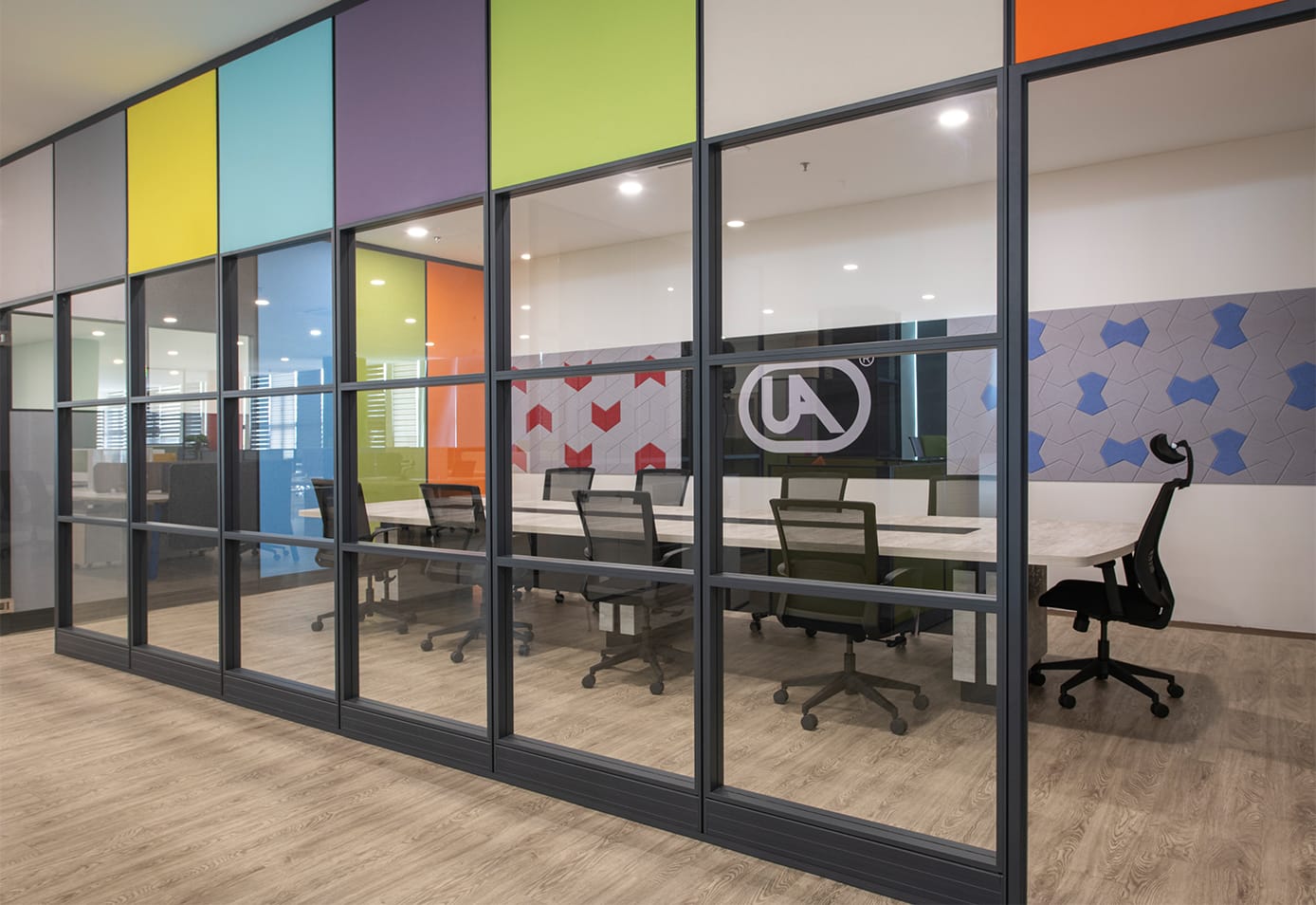
A glass-partitioned meeting room built into our showroom floor. A junction detail is far quicker to judge standing in front of it than on a drawing.
Bring the floor plan while you are there. Talking layout with the people who will build the furniture goes differently from talking to a reseller pricing a catalogue. And if you are still deciding who should hold the whole scope, supplier versus fit-out contractor sets out how the responsibilities usually split.
Where imported genuinely wins
An article from a manufacturer that finds no case for the alternative is not worth reading. There are two, and they are real.
You need it this week
Made-to-order has a floor on lead time: it has to be made. If a new team starts on Monday and you need twelve desks and twelve chairs by Friday, stock is the answer — imported or local. Nobody should sell you a production slot when what you need is a warehouse. Plenty of Malaysian offices open on stock furniture and re-fit properly at the next lease event. There is nothing wrong with that sequence.
Commodity items with enormous global volume
On some categories the international brands have spent decades and serious money on research, tooling and scale — task seating is the clearest case. A well-known ergonomic chair carries millions of units of engineering behind its mechanism, and for intensive desk roles some buyers will rightly specify it and pay for it. We supply seating, and we are straightforward about the fact that not every category is one we manufacture ourselves. Where the imported product is better for your use case, specify the imported product.

Seating display in the showroom. Chairs are the category where the case for an imported specification is strongest, and the one nobody should order without sitting in first.
What imported does not win on is a whole floor of workstations, panels and storage that has to fit an irregular plate, carry your colours, and still be matchable in year five.
Side by side
| Imported (catalogue, shipped in) | Made to order in Malaysia | |
|---|---|---|
| Lead time | Overseas production plus sailing, transhipment and customs; the ETA is an estimate you cannot influence | A factory schedule that can be sequenced, phased or held to match your site |
| Availability today | Strong where the dealer holds stock — take it off the shelf | Nothing is on a shelf; everything is made |
| Fit to your floor plate | Catalogue increments; the room adapts to the product | Drawn to your columns, risers and clearances |
| Colour and finish | The range that travels well — typically a safe, narrow palette | Your palette, in project quantity |
| Matching in year five | Depends on the range still existing and a shipment being viable | A re-run of a job already on file, at small quantities |
| Damage repair | Claim through the dealer, then wait for the part | The maker builds the replacement part |
| Warranty chain | Overseas maker via a local dealer relationship | The company that made and installed it |
| Inspecting before you buy | Sample, brochure, dealer showroom | Walk the maker’s own showroom and see the build |
| Best for | Immediate need; a specific researched product, seating especially | Whole floors, awkward plates, brand colours, anything you will extend later |
How most Malaysian offices buy
Almost nobody goes all one way, and the sensible split has held steady for years.
- Workstations, panels, storage, reception and meeting furniture — made to order. This is the bulk of the floor, the part that has to fit the plate, carry the brand, and be extended when headcount moves.
- Task seating — specified on merit, imported or local, chosen by sitting in it rather than by origin.
- Anything needed inside two weeks — stock, and re-specified properly at the next move.
The one thing worth avoiding is buying a whole floor from a catalogue simply because the catalogue arrived first. Fit, colour and future matching are cheap to get right at specification and expensive to fix afterwards.
UA Office has manufactured office furniture in Malaysia since 1991. Our panel and partition systems are built in our own factory in Selangor and the rest of the range is made to order, then delivered and installed by the same team. Head office, factory and showroom share one address in Seri Kembangan, which is everything above in one line: one party made it, one party installed it, and one party picks up the phone in year three.
Frequently asked questions
Is imported office furniture better quality than Malaysian-made?
Not as a rule. Quality follows specification, materials and the maker’s standards, not the country stamped on the carton — Malaysia exported RM9.9 billion of wood furniture in 2024, much of it sold as imported furniture elsewhere. Where imported brands hold a real advantage is in categories with enormous global engineering volume behind them, task seating above all. On workstations, panels, storage and tables, a capable Malaysian manufacturer matches the build and adds exact fit.
How much longer does imported office furniture take to arrive in Malaysia?
It depends on the route and whether the item is stocked locally, but the structural point is that an imported lead time contains links nobody in Malaysia controls. Sea-Intelligence measured global container schedule reliability at 56.4% in July 2026, with late vessels averaging 6.06 days behind schedule. Locally made furniture has a production lead time too — the difference is that it is a schedule the manufacturer sets and can re-sequence around your site.
What happens if a panel is damaged two years after installation?
With made-to-order furniture from a local manufacturer, the replacement is a re-run of your original job: the same fabric reference, frame section and panel height, made as a small order. With imported catalogue stock, it depends on whether that model and fabric are still in the current range and whether a shipment can be justified for one part, which is how a floor ends up looking like two separate orders. Ask any supplier this question before you order, and ask for the answer in writing.
Can I get office furniture in my company’s brand colours?
With made-to-order, yes — the fabric on a workstation panel is a specified variable, so the palette is chosen at design stage rather than picked from what the container carried. Imported ranges usually offer a narrower set of finishes, because a global shipping programme is built around colours that sell in every market. If brand colour across a whole floor matters to you, raise it at the first layout conversation, not after the quote.
Should we mix imported and locally made office furniture?
Usually, yes. The common pattern in Malaysian offices is made-to-order for the workstations, panels, storage and meeting furniture that define the floor, imported or stock for a handful of items chosen on merit or urgency — task chairs most often. Nobody should feel they compromised by landing there.
Can we visit the factory before ordering?
Ask, and judge the answer. Our head office, factory and showroom are at one address in Seri Kembangan, Selangor, so coming to the showroom means coming to the maker’s own premises — the people and the production are behind the same door. The showroom itself is set up so you can sit in the seating and handle the panel construction before committing to a floor of it. Bring your plan; a layout conversation with the people who will build the furniture is worth more than an hour of brochures.
- Sea-Intelligence (2026). Global schedule reliability falls to 56.4% in July, reporting the Global Liner Performance report, issue 180 (34 trade lanes, 60+ carriers). Via Container News.
- The Star (1 March 2025). Malaysia’s export of wood furniture grew 8.4% to RM9.9bil last year — figures announced at the Malaysian International Furniture Fair by the Plantation and Commodities Ministry.
Bring the floor plan. We’ll quote what fits it.
UA Office manufactures office partition and panel systems in our own Selangor factory and makes the rest of the range to order — your dimensions, your finishes, delivered and installed by the same team. Send your layout, headcount and target date and a specialist will come back to you.
Request a quote →