Built-In vs Loose Office Furniture in Malaysia: Which to Use Where
- One question settles most of it: when you hand the unit back, does this piece leave with you? Loose furniture does; built-in stays where it is.
- Built-in territory: reception counters, pantry and tea-point cabinetry, full-height storage walls, AV and feature walls, awkward corners and window benches.
- Loose territory: workstations, task and meeting seating, mobile pedestals, meeting tables, freestanding storage that doubles as a divider.
- Three things push the line: your lease and its reinstatement clause, how the two get treated for capital allowances, and how often you expect to redraw the floor.
- Built-in is joinery built into the shell; loose furniture is manufactured to a spec. UA Office has made both in-house, in its own factory, since 1991 — nothing here is imported and re-badged.
Every office layout eventually hits the same fork. Someone points at the drawing and asks whether the storage should be a run of cabinets bolted to the wall, or a line of freestanding units you could push somewhere else next year. Multiply that by reception, the pantry, the boardroom credenza, the filing wall and the window bay, and you have the whole built-in versus loose decision in front of you.
Taste barely comes into it, and cost is not what decides it either. What you are settling is which zones are fixed and which are going to move, and what happens to all of it when the lease runs out.
The usual split on a Malaysian floor plate: fixed-function zones pushed to the perimeter and built in; the working floor kept loose so it can be redrawn.
The only line that really matters
Built-in — fitted furniture, joinery, casework, whatever your contractor calls it — is constructed into the space during the fit-out and fixed to walls, floors or structure. Loose furniture is freestanding: it arrives finished, it gets positioned, and it can be repositioned.
The practical consequence is blunt. Built-in improves a unit you do not own. Loose furniture is an asset on your books that goes in the lorry when you move. Everything else — space efficiency, finish quality, lead time, tax treatment — follows from that one fact.
So the question is never “built-in or loose?” in the abstract. It is always for this zone, in this unit, on this lease — which one?
Built-in territory: where fitting it in wins
Build in where the function will not move and the millimetres matter. Five zones account for most of it.
Reception and front-of-house
A reception counter is the one piece almost nobody keeps loose. It has to sit in a specific spot relative to the lift lobby and the entrance, it carries the brand, it usually integrates power, data and a logo wall behind it, and it wants to look like part of the architecture rather than a product that was delivered. Stone, timber and a continuous top do that; a freestanding counter rarely does.
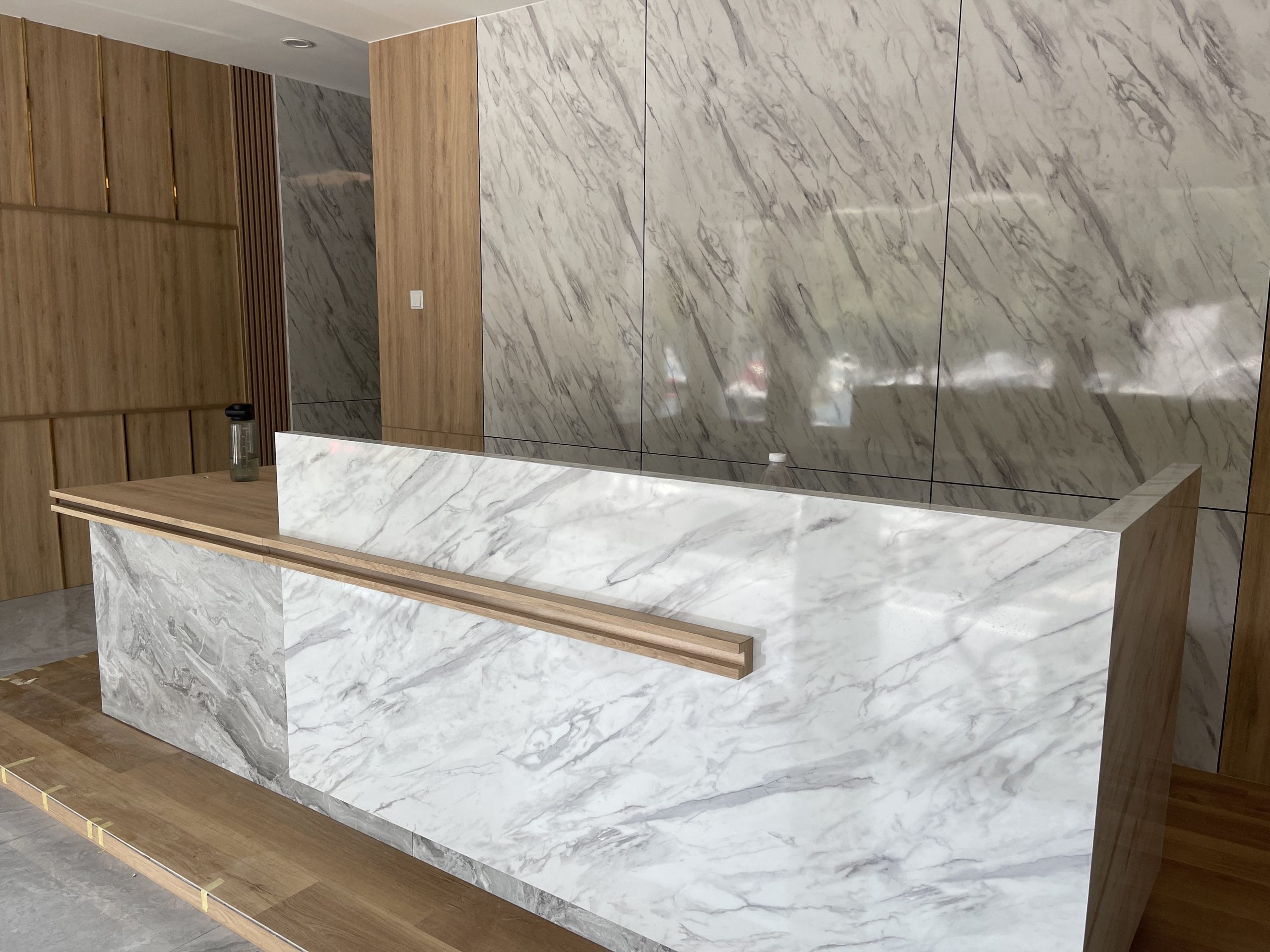
A reception counter built into the lobby: marble carried from the wall onto the counter face, and a timber reveal running through both. It cannot be relocated, and it stays with the unit when you leave.
Pantry and tea points
Pantries are plumbed. Once there is a sink, a water point and a run of appliances, the cabinetry has to be built around them, and the worktop wants to be one continuous surface rather than a line of separate tables. Pantry joinery is also where tight footprints get rescued — a 2.4 m tea point in a corner only works if the cabinets are cut to the corner.
Full-height storage walls
If storage needs to reach the ceiling, it needs to be fixed to the wall. Freestanding cabinets stop around 1.8 m for good reason. A floor-to-ceiling run also buys you the thing loose storage cannot: a flat, quiet wall instead of a row of boxes with gaps between them and dust on top.

Both approaches in one room. The timber wall and the credenza under the glazing are built in and stay put; the L-desk and the pedestal in front of them are loose and would travel.
Feature, AV and utility walls
Anything that hides cabling, houses a display, conceals a riser or fronts a server cupboard is joinery by nature. The same goes for the fluted panelling and lit niches that get used to lift a director’s room — those are wall treatments with shelves in them, not furniture.
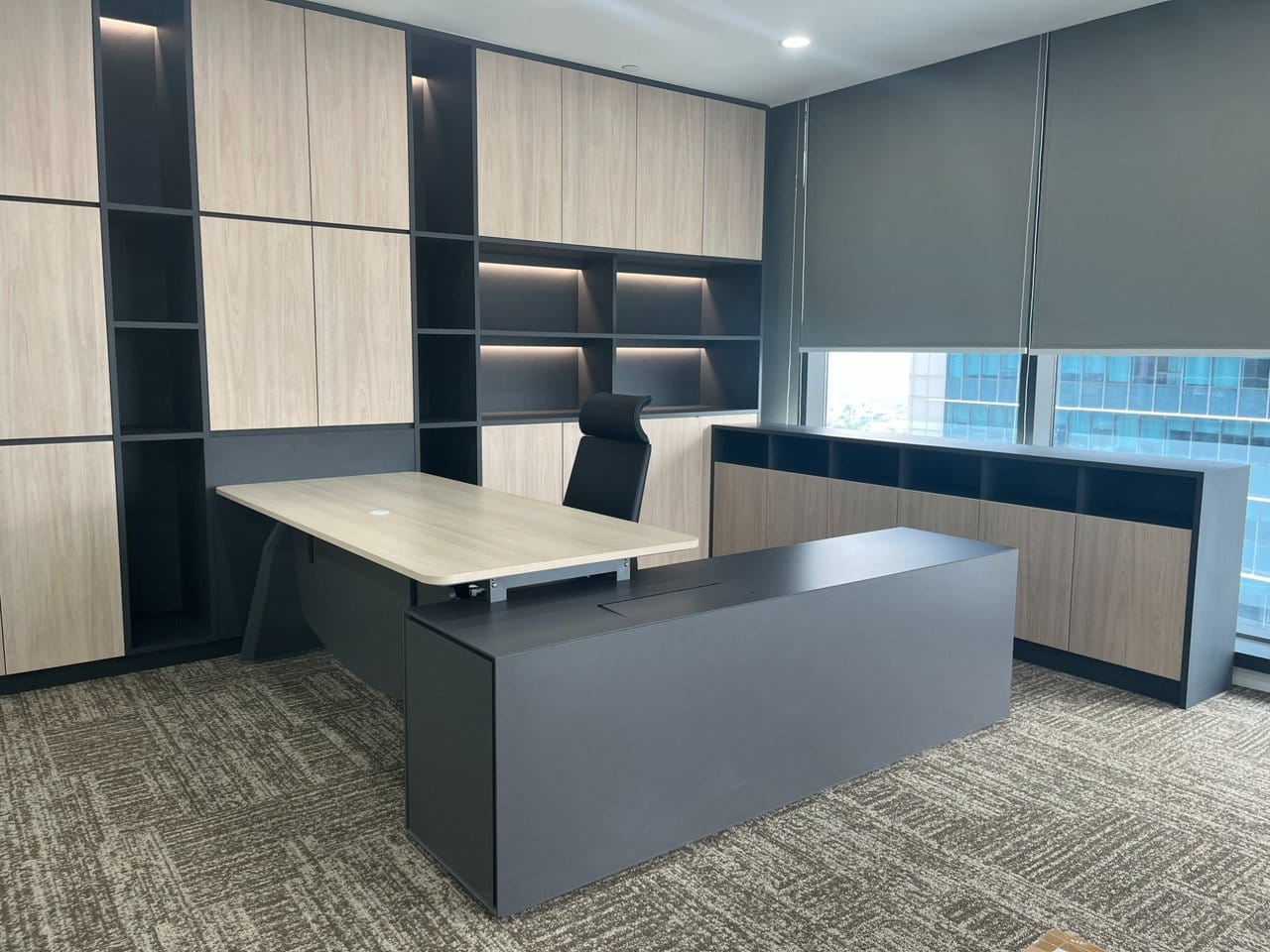
Built-in cabinetry taken to the ceiling with lit display niches worked into it. The desk and the credenza in front of it are loose pieces, made to the same finish palette but not fixed to anything.
Awkward corners and window benches
Very few Malaysian floor plates are square all the way round. There are columns to work past, riser boxes in the wrong place, window sills at an inconvenient height. Those are exactly the spots where a catalogue-size cabinet leaves a 200 mm gap and built-in joinery does not. If you are losing usable area to a bad corner, that corner is a built-in candidate.
Loose territory: where movable wins
Keep it loose everywhere the layout is a working hypothesis rather than a permanent decision — which, on most floors, is the entire open plan.
- Workstations and desks. Headcount changes. Teams merge, split and get re-seated. A desk run you can re-pitch over a weekend is worth more than a slightly neater one you cannot. See our guide to choosing an office workstation supplier in Malaysia for how the desk system itself gets specified.
- Task, meeting and visitor seating. Obviously loose — but worth saying, because chairs are usually the single largest count of items you carry to the next office, and the easiest value to preserve.
- Mobile pedestals and freestanding cabinets. Storage that follows the person around the floor.
- Meeting and boardroom tables. Even an eight-metre table is loose furniture: built in sections, carried in, and carried out again.
- Storage used as a divider. A run of lockable units at the end of a desk bay does the same job as a low wall, and can be re-drawn later. Where you need real separation rather than a visual break, that is what a partition panel system is for: fabric over foam on an MDF core in an aluminium frame, and demountable in a way fixed drywall is not.
Ask the person who will run the office, not the person signing the drawing: “if we hire fifteen more people next year, what has to change?” Everything named in the answer should be loose. The rest is a built-in candidate.
Zone by zone: the default call
Defaults, not rules. A ten-year lease pushes several of these rows the other way, and so does a shell you expect to sublet.
| Zone | Default | Why — and when to flip it |
|---|---|---|
| Reception counter | Built-in | Fixed position, brand-critical, integrates services. Flip it loose only for very short leases or serviced units. |
| Pantry & tea point | Built-in | Plumbing and appliances anchor it; continuous worktop rescues tight footprints. |
| Full-height storage wall | Built-in | Anything above roughly 1.8 m needs fixing back. Flip loose if the archive is temporary. |
| AV, feature & utility walls | Built-in | Cable management and riser access make it joinery by nature. |
| Workstations | Loose | The one thing guaranteed to be re-planned. Keep it movable and keep it yours. |
| Task & meeting seating | Loose | Highest-count asset you can redeploy at the next office. |
| Meeting / boardroom tables | Loose | Made to the room’s dimensions but still demountable and transportable. |
| Filing & personal storage | Loose | Pedestals and freestanding units move with the team; they also work as bay dividers. |
| Director’s room | Mixed | Backdrop joinery built in; desk, credenza and seating loose in a matching finish. |
| Awkward corners & window bays | Built-in | The only way to stop losing usable area to a column or a kink in the perimeter. |
Your lease decides more than your taste does
Two clauses in a Malaysian commercial tenancy agreement do most of the work here, and they pull in opposite directions.
The first is the length of the term. Built-in joinery is an improvement to premises you are renting. On a three-year term with one option to renew, every ringgit of fixed joinery is a ringgit you are writing off fast. On a nine- or twelve-year term it is spread over enough time to be sensible.
The second is the reinstatement clause — also written as a restoration or “make good” clause. Malaysian commercial tenancies commonly oblige the tenant to put the premises back to their original condition at the end of the term unless the landlord agrees otherwise in writing, and deposit refunds are typically conditional on it.1 That means the built-in work is often paid for twice: once to install it, and again at the end to strip it out, patch the walls and repaint.
Read your reinstatement clause first, and check three things:
- Does it require the unit back as bare shell, or as-handed-over (which may already include a ceiling, flooring and lighting)?
- Can specific items be waived in writing and left behind — landlords often accept a good reception counter or pantry rather than pay to rebuild one?
- Is reinstatement capped, or is it open-ended and deducted from the deposit?
The answers routinely move a zone from the built-in column to the loose column, and it costs nothing to ask before the design is frozen.
The practical middle path most tenants land on: build in the front-of-house and the tight zones, keep the working floor loose, and get any leave-behind items agreed with the landlord in writing at the start rather than negotiated in a hurry at the end.
Tax, depreciation and what “plant” means
This is the part most layout discussions skip, and it can be worth more than the finish debate.
Loose office furniture and fittings are the straightforward case. Under Schedule 3 of the Income Tax Act 1967, office equipment, furniture and fittings attract an initial allowance of 20% and an annual allowance of 10%, against 14% annual for general plant and machinery.2 The asset is yours, it is on your register, and if you sell or scrap it there is a balancing allowance or charge.
Built-in joinery is less tidy, because paragraph 70A of Schedule 3 defines “plant” as an apparatus used for carrying on a business but excludes a building, and any asset used and functioning as a place within which a business is carried on.3,4 The intent was to stop the structure itself being claimed as plant. Where a given piece of fitted joinery falls relative to that line is a judgement call, and it depends on the item.
None of which is tax advice, and this article is not the place to get it. The point for the layout meeting is narrower and still useful: the built-in / loose split has a tax shape as well as a design shape, so it is worth putting in front of your accountant while the drawings are still changeable rather than after the joinery is installed.
Timeline: they are not built the same way
Built-in and loose furniture sit at different points in a fit-out programme, and confusing them is a reliable way to lose two weeks.
Joinery is site work. It cannot be finally measured until the walls are up, the floor level is known and the M&E first fix is in. Then it is fabricated, delivered in sections and installed in place — usually with a snagging tail, because it is fitted against surfaces that are never perfectly straight.
Loose furniture is factory work. It is manufactured to your approved specification while the site is still being built, then delivered and positioned near the end. It does not need the wall to be finished, and it does not stop the next trade.
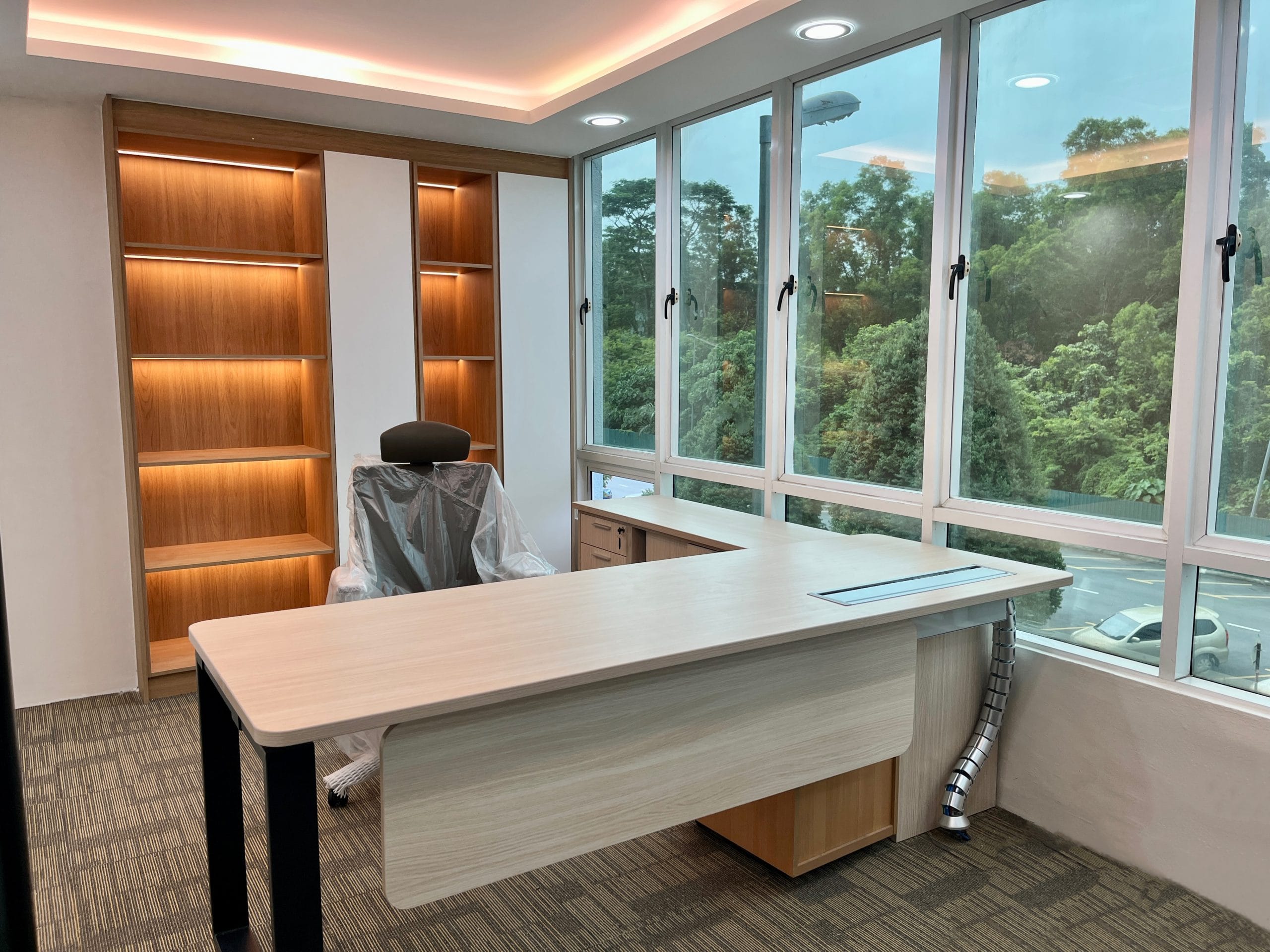
The two programmes meeting at handover: the lit bookcase behind was built into the wall on site, the curved-top desk was manufactured to spec and carried in. The chair has not been unwrapped yet.
Where this bites is sequencing. If the pantry joinery is late, the pantry is late. If the desks are late, the whole move-in is late — but the desks were never dependent on the wall, so that delay is almost always avoidable with an earlier sign-off on the furniture specification.
Drawing the split on your own plan
A well-planned Malaysian office uses both, and the two get designed together rather than in sequence. Four things make that work.
Match the finishes deliberately. A built-in cabinet wall and the loose credenza in front of it should share a laminate or veneer reference, an edge detail and a handle. When the joinery and the furniture come out of the same factory, that is a specification decision. When they come from two suppliers, it is a hope.
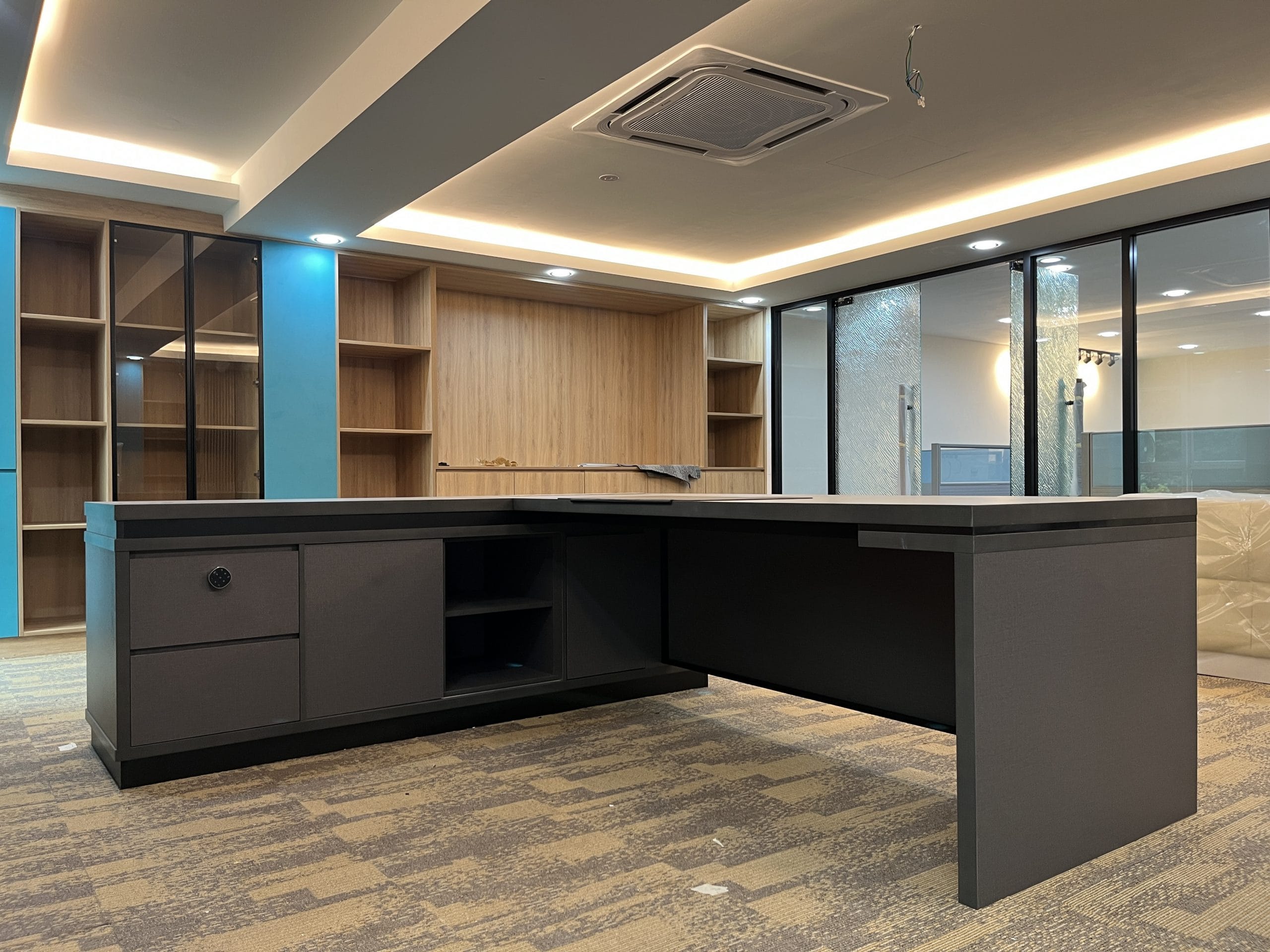
Built-in shelving and pantry joinery on the back wall, a loose desk and side unit in front. Two separate things to buy, and one conversation about finishes.
Draw the dimensions once. The clearance between a built-in storage wall and the first desk row is a joinery dimension and a furniture dimension at the same time. Deciding it twice is how you end up with a drawer that will not open.
Keep the loose specification honest. Made-to-order does not mean fixed. A desk built to your exact module and your exact finish is still loose furniture, and it still walks out of the building with you. That distinction is what the separate guide to custom versus ready-made office furniture covers in detail, and it is worth reading alongside this one.
Know who is manufacturing what. UA Office has been manufacturing office furniture in Malaysia since 1991, in its own factory, made to order — not sourced from a catalogue and re-badged. We handle the fitted joinery and the loose furniture as one project, which mostly buys you cleaner scheduling and finishes that match. If you are still deciding how to structure the work at all, supplier versus fit-out contractor sets out the two routes. It also matters at the other end of the lease: when you move, we dismantle and reinstall furniture we supplied, and because the drawings and finish references are already on file, setting it out again in a new office is a short exercise rather than a fresh survey.
Cost depends on scope, finishes, layout and quantity; nothing in this guide is a quote. The fastest way to a real answer is a floor plan with headcount on it and a copy of the lease terms that matter.
Frequently asked questions
What is the difference between built-in and loose office furniture?
Built-in (fitted) furniture is joinery constructed into the space during the fit-out and fixed to walls, floors or structure — reception counters, pantry cabinetry, full-height storage walls. It stays with the unit when the lease ends. Loose furniture is freestanding and movable — desks, chairs, meeting tables, mobile pedestals — so it can be reconfigured on the floor and relocated to your next office.
Which office areas should be built-in?
Zones where the function is fixed and the millimetres matter: reception and front-of-house counters, pantry and tea-point cabinetry, full-height storage walls, AV, feature and utility walls, and awkward corners or window bays where a standard cabinet would leave dead space. These rarely move, they usually integrate services, and a fitted solution recovers floor area that a freestanding one wastes.
Does a reinstatement clause change the built-in versus loose decision?
Often, yes. Malaysian commercial tenancies commonly require the tenant to restore the premises to their original condition at the end of the term unless the landlord agrees otherwise in writing, with deposit refunds conditional on it. That means fixed joinery can carry a removal cost at the end as well as an installation cost at the start. Read the clause before the design is frozen, and ask the landlord in writing which items may be left behind — a good reception counter or pantry is sometimes welcome rather than a liability.
Is built-in furniture more expensive than loose furniture?
Neither is simply cheaper; they are budgeted differently. Built-in sits inside the fit-out cost and improves a unit you hand back; loose furniture is an asset that stays on your books and moves with you. The comparison that matters covers the whole term: what it costs to install, how it is treated for capital allowances, what it is worth at the end, and what reinstatement will cost if it has to come out.
How does the tax treatment differ?
Loose office furniture and fittings are claimed as office equipment, furniture and fittings under Schedule 3 of the Income Tax Act 1967, at 20% initial allowance and 10% annual allowance. Fitted joinery is less clear-cut, because paragraph 70A excludes from “plant” any asset that functions as a place within which the business is carried on. Where a particular item sits relative to that line is a judgement call — put the split in front of your tax agent while the drawings can still change.
Can one company do both the built-in joinery and the loose furniture?
Yes, and it removes the two most common failure points: mismatched finishes and mis-sequenced programmes. A team that runs the fit-out and manufactures the furniture can hold one finish schedule and one set of dimensions across both. UA Office does both in-house, manufacturing made-to-order in its own factory since 1991, installing across Peninsular Malaysia.
- L.H. Low & Co. Frequently Asked Questions: Commercial Tenancy Agreements (Malaysia) — on reinstatement to original condition and deposit refunds.
- Malaysia Tax (hasilnet.org.my). Capital Allowance Types and Rates — initial and annual allowance rates by asset class.
- RDS Law Partners. Definition of “Plant” for Capital Allowance: The Effect of Paragraph 70A.
- CCS & Co. Redefinition of ‘Plant’ for the Purpose of Capital Allowances — current wording of paragraph 70A.
General guidance only, not legal or tax advice. Confirm lease and tax positions with your own solicitor and tax agent.
Send the plan and we’ll mark the split.
Tell us the headcount, the lease term and which zones you expect to redraw, and we’ll show you what should be fitted joinery and what should stay loose. UA Office manufactures both, made to order, in its own factory since 1991 — meet the manufacturer.
Get a layout-based quote →